
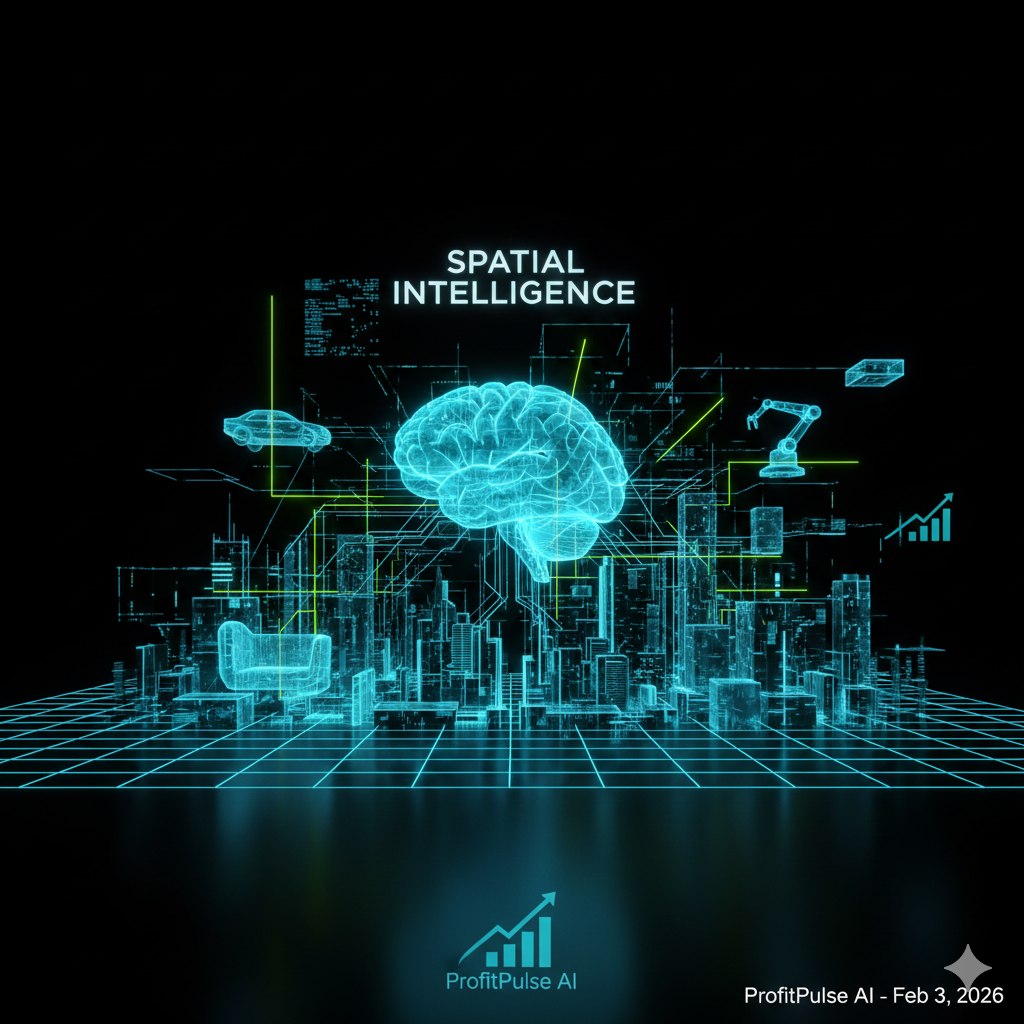
The Brief: If 2023 was the year of “Text” and 2025 was the year of “Agents,” then 2027 will be defined by Spatial Intelligence. For the first time, AI is stepping out of the screen and into the three-dimensional world. At ProfitPulse AI, we are tracking the shift from Large Language Models (LLMs) to Large World Models (LWMs).
1. What is Spatial Intelligence?
Current AI—even the most advanced agents of 2026—is essentially “flat.” It processes patterns in text and pixels but lacks an innate understanding of physics, gravity, or how objects relate to one another in a physical room.
Spatial Intelligence is the evolutionary leap where AI develops a “sense of space.” By fusing camera data, Lidar, and physical simulations, AI is graduating from predicting the next word to predicting the next physical outcome .
2. The 2027 Disruptors: Large World Models (LWMs)
The transition to a spatially aware future is driven by a new architecture known as Large World Models. Unlike current models that hallucinate physics, LWMs are trained on 3D data to understand the “Ground Truth” of reality:
- Generative Physics: Future video agents won’t just generate a scene; they will simulate it. This means AI-generated furniture will have “weight,” and light will bounce off surfaces with mathematical precision.
- Agentic Robotics: This is the “brain” humanoid robots have been waiting for. By 2027, robots will navigate complex environments not because they were pre-programmed, but because they can “see” and “reason” through space in real-time.
3. The Impact on “Agentic Commerce”
For the digital entrepreneur, this shift changes the marketing game entirely:
- Immersive “Explore-to-Buy”: E-commerce is moving from 2D grids to 3D showrooms. Spatial AI will allow customers to virtually “place” products in their homes with 100% accuracy, virtually eliminating the “uncertainty gap” in high-ticket sales.
- Hyper-Contextual Marketing: Imagine an AI assistant that understands not just what you are looking for, but where you are in the physical world—providing real-time insights based on your immediate surroundings.
The Pulse Verdict
The 2026 economy is digital, but the 2027 economy is dimensional. Companies that start architecting their brands for spatial environments today will be the “Sovereign Entities” of tomorrow.
The future isn’t just intelligent; it’s physical.
While we wait for the 3D revolution, the smartest move today is mastering the tools we have. Check out our AI Tool Review: The 2026 Essential Tech Stack to see which agents are already bridging the gap between digital and physical productivity.”
The true power of a logic-based agent like Claude isn’t just in chatting—it’s in creation. Once you’ve mastered the interface, the next step is moving Beyond Prompts: How to Build Your First “AI Employee” in 2026 to fully automate your workflow.