
Managing corporate communications manually is a massive operational drain. Support teams spend hours daily digging through internal files and complex documentation just to answer predictable client queries. To maximize your operational margins, you can easily deploy modern automation to reduce b2b customer support costs without sacrificing service quality.
By utilizing secure, no-code infrastructure, businesses can completely bypass expensive development agencies. Implementing an automated data routing framework allows your operation to field client inquiries instantly, clearing internal backlogs and optimizing staff productivity in under 10 minutes.
The High Overhead of Information Fragmentation
In a traditional corporate ecosystem, identifying workflows that can reduce b2b customer support costs is often hindered by information fragmentation. Instead, delays are caused by an operational bottleneck known as information fragmentation. Critical data—ranging from legacy product manuals and technical specification sheets to client contract clauses and corporate policy updates—is typically scattered across siloed environments. Agents routinely waste between 30% and 40% of their billable hours hunting down buried details across disparate platforms just to answer basic, repetitive inquiries.
When a customer support operation relies entirely on manual searching, scaling your business forces a linear expense curve. To handle a higher volume of corporate accounts, you are forced to hire more human operators. This model drives up hiring costs, spikes employee burnout rates, and results in slow response times that can damage customer retention. True scaling requires decoupling your support capability from linear headcount growth. By centralizing fragmented data access into a unified layer, an organization can automate the handling of repetitive inquiries, ensuring instant resolution times and driving down total operational overhead.
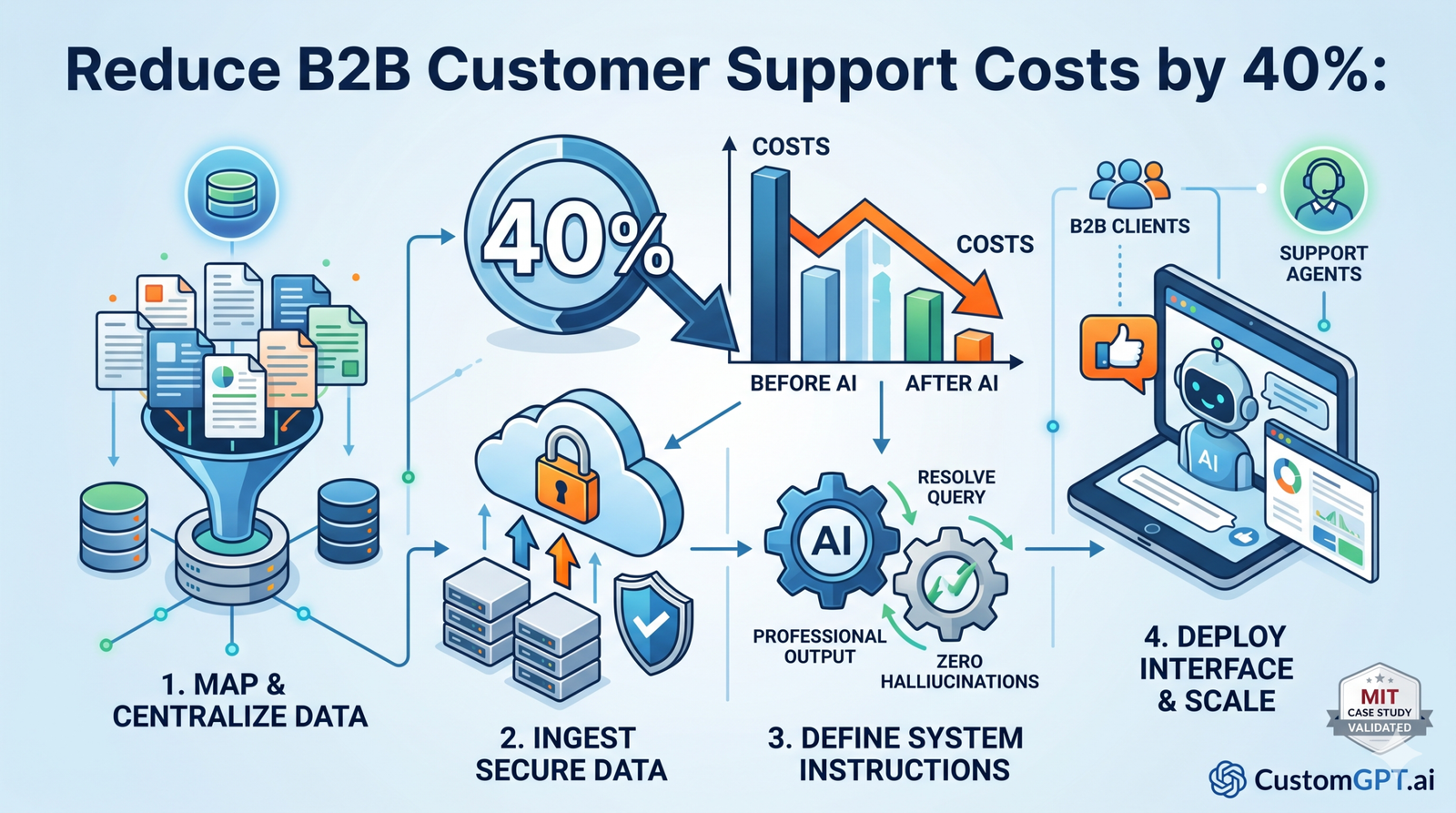
4 Steps to Reduce B2B Customer Support Costs
Transitioning from high-overhead manual operations to automated customer routing does not require complex software development cycles or enterprise-level programming teams. By utilizing a secure, no-code infrastructure, you can fully automate information delivery in four highly structured steps:
- Map and Centralize Repetitive Data Silos: Identify the core documents that resolve 80% of daily inbound customer questions. This includes compiling updated FAQs, system operation manuals, corporate policies, and past resolution logs into a clean, dedicated digital folder.
- Ingest Secure Corporate Data: Upload the compiled files directly into a secure, sandboxed AI environment. It is critical to select an infrastructure partner that treats this data with strict confidentiality, ensuring your corporate assets are never mixed with public models or used for external training purposes.
- Define Custom System Instructions: Set clear operational boundaries and behavioral parameters for the automated system. Instruct the layout to reply strictly using professional, brand-aligned terminology, and specify exactly how to handle complex inquiries that require human escalation.
- Deploy the Interface via Secure Widget or API: Integrate the finalized interface directly onto your client portals, internal communication dashboards, or live website support spaces. This immediate integration is the fastest way to reduce b2b customer support costs while scaling your operational availability around the clock.
Why RAG Architecture Eliminates Hallucinations
The biggest point of hesitation for B2B executives adopting artificial intelligence is the risk of “hallucinations”—a phenomenon where standard public models make up false facts, incorrect pricing, or imaginary features when they don’t know the true answer. In a commercial business environment, providing an inaccurate answer to a client can lead to serious legal liabilities and fractured contractual partnerships.
To completely eliminate this risk, modern enterprise applications deploy a data routing framework known as Retrieval-Augmented Generation (RAG). Instead of relying on a model’s public memory, RAG forces the system to treat your uploaded corporate documents as a closed, absolute source of truth. When a user submits an inquiry, the system searches your secure data repository first, extracts the exact relevant facts, and uses the language model solely to summarize those facts into a clear, natural response. If the information is not explicitly stated within your uploaded files, the system will decline to answer rather than fabricating a response. This foundational security model ensures absolute factual precision while maintaining the speed and efficiency of automated operations.
🎓 Validated by Top-Tier Enterprise Institutions
Deploying automation to reduce b2b customer support costs isn’t an experimental gamble—it is a proven corporate strategy. CustomGPT.ai has been trusted by MIT (Massachusetts Institute of Technology) for over two years to safely ingest and manage highly complex operational data models.
Review the official MIT Case Study to see exactly how elite institutions leverage secure RAG technology to handle thousands of requests with zero errors.